
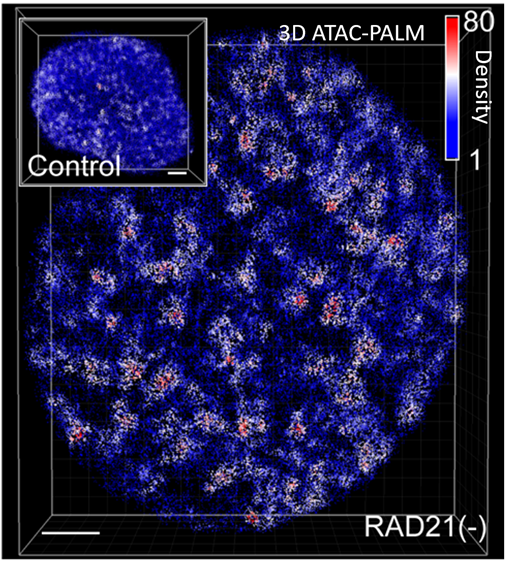
Structural changes in accessible chromatin revealed by 3D ATAC-PALM before and after cohesin depletion | Learn More →
Sox2 enhancer clusters in a living mESC | Learn More →
Genome Organization & Gene Regulation
Imaging how the genome is organized in space and how that organization shapes gene expression:
The genome is not a linear sequence inside the nucleus. It folds into a dynamic three-dimensional structure in which regulatory elements, genes, and chromatin domains interact across space. Understanding how this organization influences gene regulation requires measurements that preserve both spatial structure and cell-to-cell variation.
Sequencing-based methods such as Hi-C and ATAC-seq have transformed our understanding of genome organization, but they primarily reveal population-averaged features. We wanted to see the 3D genome, specifically the accessible chromatin that drives gene regulation, directly in individual cells at nanometer resolution.
The technology: 3D ATAC-PALM:
We invented 3D ATAC-PALM by integrating ATAC (Assay for Transposase-Accessible Chromatin) with Tn5-mediated insertion of photoactivatable fluorophores, imaged by lattice light-sheet PALM microscopy. This provides nanoscale, whole-nucleus maps of the accessible genome in single cells (Xie & Dong et al., Nature Methods 2020).
Paired with single-molecule residence-time imaging of transcription factors, 3D ATAC-PALM enables simultaneous measurement of chromatin structure and protein-binding dynamics in the same cell.
What we discovered:
Using 3D ATAC-PALM together with chemical and genetic perturbations, we found that:
CTCF decompacts accessible chromatin (Xie & Dong et al., Nature Methods 2020).
Cohesin prevents spatial mixing of accessible chromatin domains by counterbalancing affinity-driven interactions mediated by BRD2, effectively compartmentalizing the accessible genome (Xie & Dong et al., Nature Genetics 2022).
Cohesin loss reshapes gene co-expression patterns in single cells rather than simply changing population-average expression levels (Dong et al., Nature Genetics 2024). This finding has direct implications for cohesinopathies such as Cornelia de Lange syndrome and suggests that 3D genome topology can regulate relationships among genes that are difficult to detect from mean expression alone.
These studies led us to a broader question: does genome organization primarily regulate the expression of individual genes, or does it also tune coordinated gene-expression states across many genes?
Our results suggest that changes in genome topology can reshape which genes are co-expressed together, even when their average expression changes only modestly. This provides one basis for our working hypothesis that regulatory architecture may act less like a collection of simple ON-OFF switches and more like a network that tunes relationships among genes.
Connecting genome organization to cell state:
Genome organization occupies an intermediate scale in our broader quantitative imaging program.
Single-molecule imaging reveals the dynamics of regulatory proteins that interact with the genome. 3D ATAC-PALM measures how those interactions are organized within three-dimensional chromatin architecture. Highly multiplexed spatial imaging with cycleHCR allows us to read out the resulting molecular states across individual cells and intact tissues.
By connecting these measurements, we aim to determine how changes in molecular behavior reshape genome organization, how genome organization alters coordinated gene expression, and how these regulatory changes ultimately influence cell state and tissue function.
Collaborative applications:
3D ATAC-PALM has also been used in collaboration to study phase-separation-driven genome reorganization by YAP (Cai et al., Nat. Cell Biol. 2019) and DNA-initiated epigenetic cascades in C9orf72 repeat expansion disease (Liu et al., Neuron 2023).
Related Publications
1. Liu, Z.@, Legant, WR., Chen, B., Li, L., Grimm, JB., Lavis, LD., Betzig, E. and Tjian, R. (2014). 3D imaging of Sox2 enhancer clusters in embryonic stem cells. eLife, 3:e04236.
2. Xie, L.*, Dong, P.*, Qi, Y., Marzio, M.D., Chen, X., Banala, S., Legant, W.R., English, B., Hansen, A., Schulmann, A., Lavis, L.D., Betzig, E., Chang, H.Y., Zhang, B., Tjian, R.@, Liu, Z.@ (2020). 3D ATAC-PALM: super-resolution imaging of the accessible genome. Nature Methods, 17(4):430-436.
3. Xie, L.*, Dong, P.*, Qi, Y., Hsieh, T.S., English, B., Jung, S., Chen, X., Marzio, M.D., Chen, X., Casellas, R., Chang, H.Y., Zhang, B.@, Tjian, R.@, Liu, Z.@ (2022) BRD2 Compartmentalizes the Accessible Genome. Nature Genetics,54(4):481-491.
4. Dong, P.@, Zhang, S., Gandin, V., Xie, L., Wang, L., Lemire, A.L., Li, W., Otsuna, H., Kawase, T., Lander, A.D., Chang. H.Y., Liu, Z.J.@ (2024) Cohesin prevents cross-domain gene co-activation. Nature Genetics, 56(8):1654-1664.
Collaborations:
1. Cai, D., Feliciano, D., Dong, P., Flores, E., Gruebele, M., Porat-Shliom, N., Sukenik, S., Liu, Z., Lippincott-Schwartz., J. (2019). Phase separation of YAP reorganizes genome topology for long-term YAP target gene expression. Nat. Cell biol., 21(12):1578-1589.
2. Liu, Y., Huang, Z., Liu, H., Ji, Z., Arora, A., Cai, D., Wang, H., Liu, M., Simko, E.A., Zhang, Y., Periz, G., Liu, Z., Wang, J. (2023) DNA-initiated epigenetic cascades driven by C9orf72 hexanucleotide repeat. Neuron, 111(8):1205-21.
3. Holland, K.L., Plutkis, S.E., Daugird, T.A., Sau, A., Grimm, J.B., English, B.P., Zheng, Q., Dave, S., Rahman, F., Xie, L., Dong, P., Tkachuk, A.N., Brown, T.A., Singer, R.H., Liu, Z.J., Galbraith, C.G., Musser, S.M., Legant, W.R., Lavis, L.D. (2026) A series of spontaneously blinking dyes for super-resolution microscopy. Nature Methods, 23(5):909-913.